
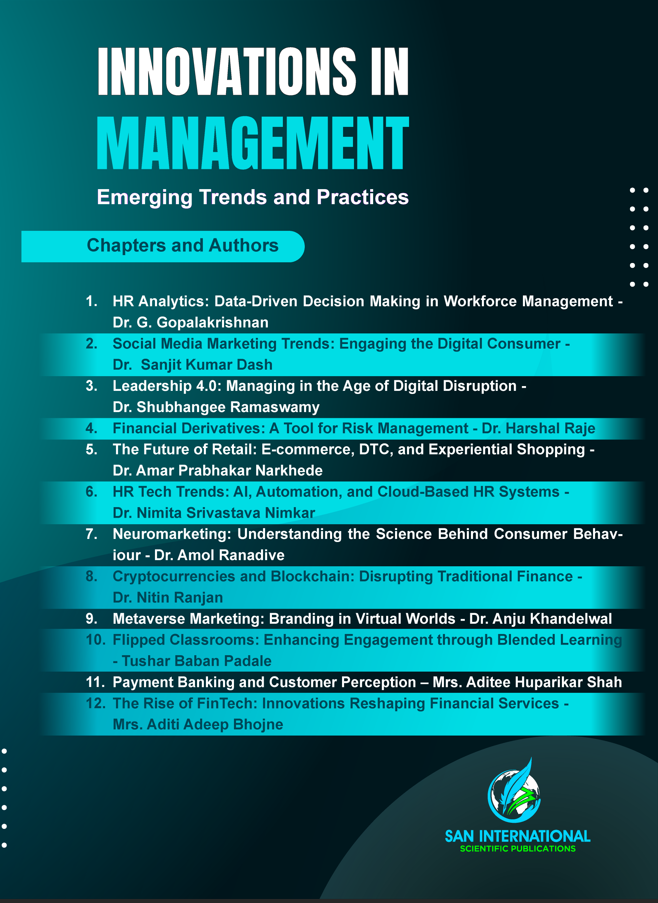
Book Title: Innovations in Management: Emerging Trends and Practices
Editor: Dr. Dattatraya Pandurang Rane
ISBN: 978-81-987266-7-4
Chapter: 4
DOI: https://doi.org/10.59646/imC4/358
Author: Dr. Harshal Raje, Associate Professor, Global Business School and Research Centre, Dr. D.Y. Patil Vidyapeeth, Pimpri, Pune, Maharashtra, India.
Abstract
Financial derivatives are powerful tools used by businesses, investors, and financial institutions to manage risk, speculate on price movements, and increase financial leverage. These contracts, whose value is derived from an underlying asset, can be applied in a variety of ways, from hedging against fluctuations in commodity prices to managing interest rate risks. The chapter explores the different types of financial derivatives—futures, options, forwards, and swaps—and their applications in risk management. It emphasizes how derivatives can mitigate financial uncertainty by locking in prices or providing flexibility in times of volatility. However, their use also comes with significant risks, including the potential for significant losses. This chapter will provide an understanding of the fundamental concepts, types, benefits, and challenges of using financial derivatives, offering practical insights into their application in risk management strategies.
References
- Black, F., & Scholes, M. (1973). The pricing of options and corporate liabilities. Journal of Political Economy, 81(3), 637-654.
- Hull, J. C. (2017). Options, Futures, and Other Derivatives (10th ed.). Pearson.
- Jorion, P. (2007). Financial Risk Management: A Practitioner’s Guide to Managing Market and Credit Risk. Wiley Finance.
- Merton, R. C. (1992). Financial innovation and the management and regulation of financial institutions. Journal of Applied Corporate Finance, 4(4), 12-22.
- Stulz, R. M. (2004). Should we fear derivatives? Journal of Economic Perspectives, 18(3), 173-191.