
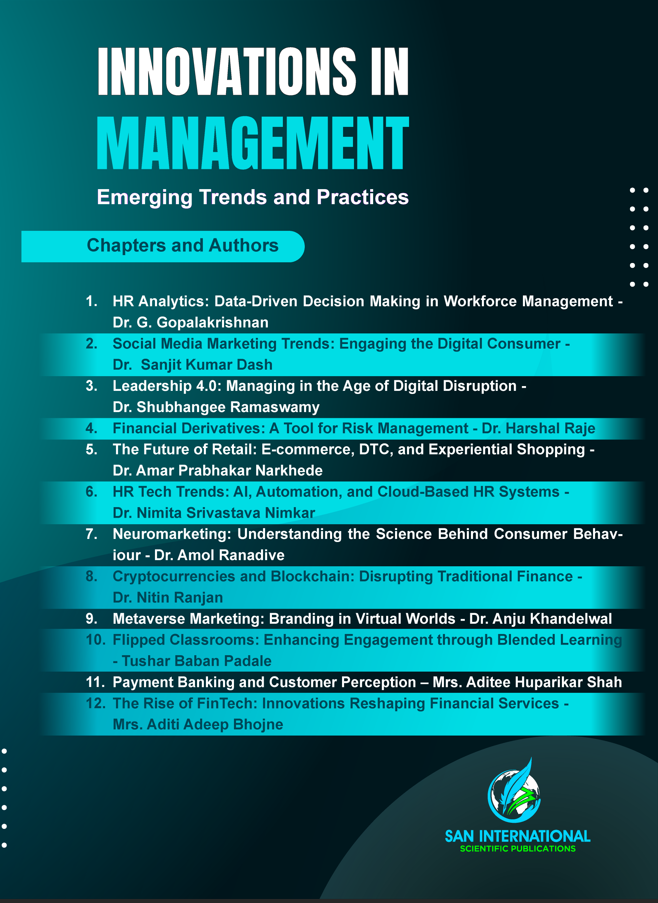
Book Title: Innovations in Management: Emerging Trends and Practices
Editor: Dr. Dattatraya Pandurang Rane
ISBN: 978-81-987266-7-4
Chapter: 8
DOI: https://doi.org/10.59646/imC8/358
Author: Dr. Nitin Ranjan, Associate Professor, International Institute of Management Studies, Pune, Maharashtra, India
Abstract
Cryptocurrencies and blockchain technology are reshaping traditional banking by facilitating decentralized, secure, and transparent transactions. Cryptocurrencies are based upon decentralized ledgers and peer-to-peer networks that are protected by cryptography. Contrast this with conventional financial systems, which rely on authoritative bodies like banks and governments. Smart contracts, decentralized finance (DeFi), asset tokenization, and digital currencies like Bitcoin and Ethereum are all made possible by blockchain technology. Blockchain and cryptocurrency are examined in this chapter along with their origins, types, and effects. Furthermore, the analysis delves into the ways these technologies have the ability to increase financial inclusion, decrease transaction costs, and democratize finance. Furthermore, it delves into important challenges including unclear regulations, issues with scaling, and cybersecurity risks, all the while analyzing the goals, advantages, and measurable outcomes of this technological revolution.
References
- Catalini, C., & Gans, J. S. (2016). Some simple economics of the blockchain. MIT Sloan Research Paper, (5191-16), 1-39.
- Gans, J. S. (2019). The case for an innovation-centric view of digital platforms. Antitrust Law Journal, 82(1), 39-52.
- Nakamoto, S. (2008). Bitcoin: A peer-to-peer electronic cash system. Bitcoin.org. Retrieved from https://bitcoin.org/bitcoin.pdf
- Tapscott, D., & Tapscott, A. (2017). How blockchain is changing finance. Harvard Business Review, 95(3), 2-5.
- Yermack, D. (2017). Corporate governance and blockchains. Review of Finance, 21(1), 7-31.