
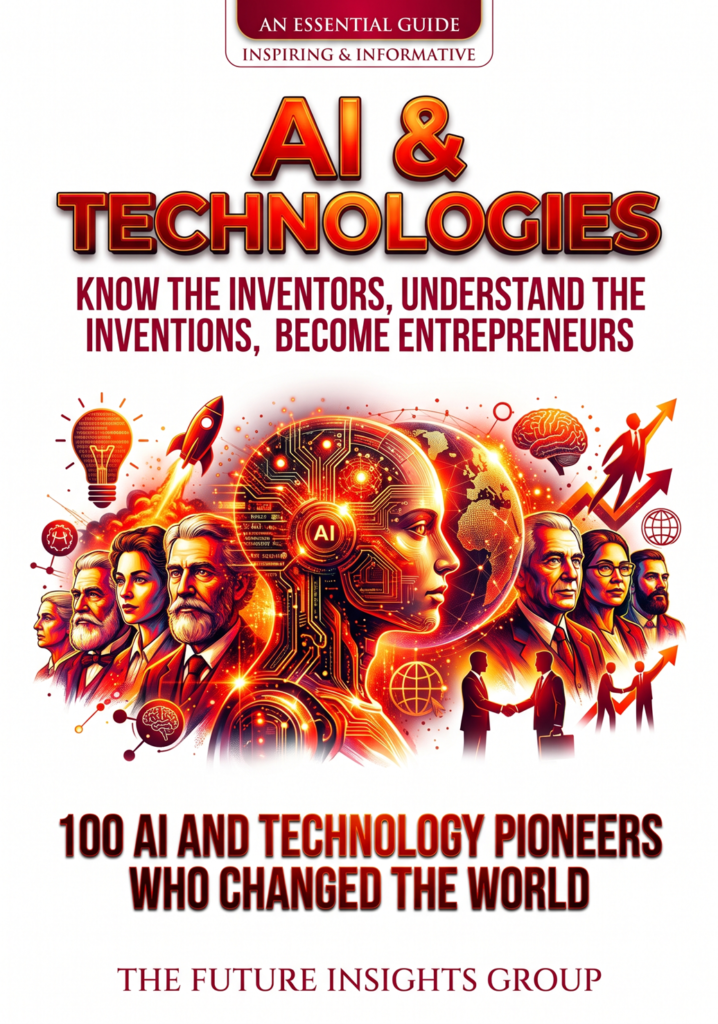
Title of the Book: AI Technologies: Know the Inventors, Understand the Inventions, Become Entrepreneurs – 100 AI and Technology Pioneers Who Changed the World
Chapter: 1
DOI: https://doi.org/10.59646/865/01
Authors: Ms. P. Kathambari, Department of Computer Science and Engineering, Sathyabama Institute of Science and Technology, Semmancheri, Chennai, Tamil Nadu, India
Abstract
Alan Mathison Turing laid the theoretical bedrock of modern computing and artificial intelligence through his twin concepts of universal algorithmic computation and machine cognition. In 1936, Turing introduced the Universal Turing Machine (UTM), establishing the mathematical boundaries of mechanical calculation and proving that a single reconfigurable machine could simulate any specialized computing apparatus. Later, in 1950, he reoriented machine intelligence from metaphysical speculation toward observable operational behavior via the Imitation Game (the Turing Test). This chapter investigates Turing’s foundational ideas, their historical realization through cryptanalysis and early hardware design, and their evolution into multi-trillion-dollar modern enterprise AI ecosystems. By connecting abstract discrete-state automata to contemporary deep learning architectures and commercial ventures, we present an entrepreneurship-oriented blueprint for turning foundational computing concepts into viable market-driven technologies.
Keywords: Universal Turing Machine, Artificial Intelligence, Turing Test, Decidability, AI Entrepreneurship
References
- Copeland, B. J. (Ed.). (2004). The Essential Turing: Seminal Writings in Computing, Logic, Philosophy, Artificial Intelligence, and Artificial Life. Oxford University Press.
- Davis, M. (2000). The Universal Computer: The Road from Leibniz to Turing. W. W. Norton & Company.
- Gödel, K. (1931). Über formal unentscheidbare Sätze der Principia Mathematica und verwandter Systeme I. Monatshefte für Mathematik und Physik, 38(1), 173–198.
- Hilbert, D., & Ackermann, W. (1928). Grundzüge der theoretischen Logik. Springer-Verlag.
- Hodges, A. (1983). Alan Turing: The Enigma. Burnett Books / Simon & Schuster.
- Hopcroft, J. E., Motwani, R., & Ullman, J. D. (2006). Introduction to Automata Theory, Languages, and Computation (3rd ed.). Pearson.
- Kahneman, D. (2011). Thinking, Fast and Slow. Farrar, Straus and Giroux.
- Russell, S., & Norvig, P. (2020). Artificial Intelligence: A Modern Approach (4th ed.). Pearson.
- Sipser, M. (2012). Introduction to the Theory of Computation (3rd ed.). Cengage Learning.
- Turing, A. M. (1936). On computable numbers, with an application to the Entscheidungsproblem. Proceedings of the London Mathematical Society, Series 2, 42(1), 230–265.
- Turing, A. M. (1950). Computing machinery and intelligence. Mind, 59(236), 433–460.
- Turing, A. M. (1952). The chemical basis of morphogenesis. Philosophical Transactions of the Royal Society of London. Series B, Biological Sciences, 237(641), 37–72.
- Vaswani, A., Shazeer, N., Parmar, N., Uszkoreit, J., Jones, L., Gomez, A. N., Kaiser, Ł., & Polosukhin, I. (2017). Attention is all you need. Advances in Neural Information Processing Systems (NeurIPS 2017), 30, 5998–6008.