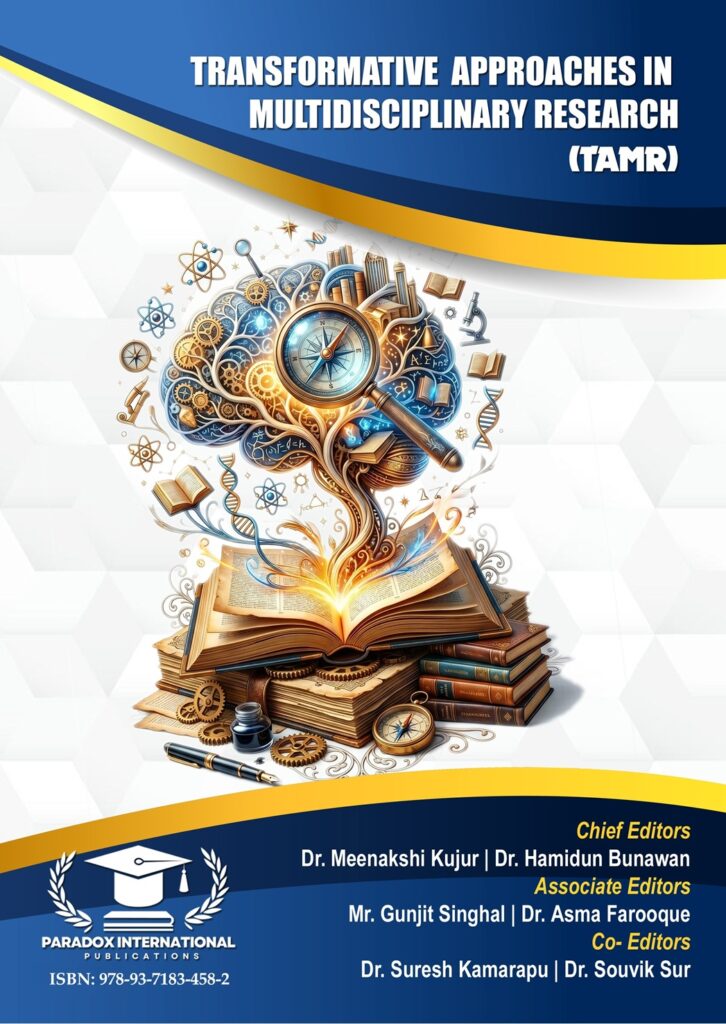
Book Title: Transformative Approaches in Multidisciplinary Research (TAMR)
Chief Editors: Dr. Meenakshi Kujur, and Dr. Hamidun Bunawan
Associate Editors: Mr. Gunjit Singhal, and Dr. Asma Farooque
Co-Editors: Dr. Suresh Kamarapu, and Dr. Souvik Sur
Chapter: 26
DOI: https://doi.org/10.59646/672/26
Author: Sabeela K Abdulsalam
Abstract
Artificial intelligence (AI) is transforming digital marketing by providing hyper-personalized, data-driven, and flexible client interaction strategies. This study examines how business understanding, customer acquisition, and retention are being redefined by AI-powered technologies, including chatbots, recommendation engines, natural language processing (NLP), machine learning-based predictive analytics, and sentiment analysis. It looks at how AI affects consumer behaviour, decision-making, and brand impression, emphasizing how intelligent systems and automation improve marketing effectiveness, maximize ad targeting, and cultivate enduring client loyalty. Important ethical issues are also covered in the study, such as algorithmic prejudice, and the necessity of using AI in marketing in a responsible and transparent manner. The paper offers insights into how AI-driven marketing tactics are changing the interaction between businesses and consumers in the digital age, finally bridging the gap between technical accuracy and human creativity, by drawing on case studies and contemporary industry examples.
References
- Chatterjee et al., (2020). The effect of AI on customer engagement and experience: An empirical study in digital marketing. Journal of Business Research, 116(1), 265–276. https://doi.org/10.1016/j.jbusres.2020.05.041
- Dwivedi et al., (2021). Artificial intelligence (AI): Multidisciplinary perspectives on emerging challenges, opportunities, and agenda for research, practice, and policy. International Journal of Information Management, 57, 101994. https://doi.org/10.1016/j.ijinfomgt.2019.101994
- Kietzmann et al., (2018). Artificial intelligence in advertising: How marketers can leverage artificial intelligence along the consumer journey. Journal of Advertising Research, 58(3), 263–267. https://doi.org/10.2501/JAR-2018-035
- Kumar et al., (2022). AI-driven customer experience management: Research directions and opportunities. Journal of Business Research, 143, 225–241. https://doi.org/10.1016/j.jbusres.2022.01.050
- Lemon, K. N., & Verhoef, P. C. (2016). Understanding customer experience throughout the customer journey. Journal of Marketing, 80(6), 69–96. https://doi.org/10.1509/jm.15.0420
- Lu, L., Cai, R., & Gursoy, D. (2019). Developing and validating a chatbot service quality scale: The role of Artificial Intelligence in hospitality. International Journal of Hospitality Management, 80, 36–51. https://doi.org/10.1016/j.ijhm.2019.01.016
- Marinchak et al., (2018). Artificial intelligence: Redefining marketing management and the customer experience. International Journal of E-Business Research, 14(3), 1–14. https://doi.org/10.4018/IJEBR.2018070101
- Mikalef et al., (2021). AI in marketing: A systematic literature review and future research agenda. European Journal of Marketing, 55(7), 1963–1991. https://doi.org/10.1108/EJM-03-2020-0186
- Paschen et al., (2020). Collaborative intelligence: How human and artificial intelligence create value along the B2B sales funnel. Business Horizons, 63(3), 403–414. https://doi.org/10.1016/j.bushor.2020.01.003
- Prentice et al., (2020). Artificial intelligence in marketing: Systematic review and future research direction. European Business Review, 32(5), 1041–1069. https://doi.org/10.1108/EBR-04-2020-0095
- Rahman, M. M., & Rahman, M. (2023). Artificial intelligence in digital marketing: Opportunities, challenges, and consumer trust. Journal of Digital Marketing and Analytics, 2(1), 45–59.
- Rust, R. T. (2020). The future of marketing. International Journal of Research in Marketing, 37(1), 15–26. https://doi.org/10.1016/j.ijresmar.2019.08.002
- Shankar, V. (2018). How artificial intelligence (AI) is reshaping retailing. Journal of Retailing, 94(4), vi–xi. https://doi.org/10.1016/S0022-4359(18)30076-9
- Syam, N., & Sharma, A. (2018). Waiting for a sales renaissance in the fourth industrial revolution: Machine learning and artificial intelligence in sales research and practice. Industrial Marketing Management, 69, 135–146. https://doi.org/10.1016/j.indmarman.2017.12.019
- Tussyadiah, I. P. (2020). A review of research into automation in tourism: Launching the Annals of Tourism Research Curated Collection on Artificial Intelligence and Robotics in Tourism. Annals of Tourism Research, 81, 102883. https://doi.org/10.1016/j.annals.2020.102883
- Verma et al., (2021). Artificial intelligence in marketing: Systematic review and future research direction. International Journal of Information Management Data Insights, 1(1), 100002. https://doi.org/10.1016/j.jjimei.2021.100002
- Wang, Y., & Siau, K. (2019). Artificial intelligence, machine learning, automation, robotics, future of work, and future of humanity: A review and research agenda. Journal of Database Management, 30(1), 61–79. https://doi.org/10.4018/JDM.2019010104
- Wirtz et al., (2019). Technology-mediated service encounters. Journal of Service Management, 30(3), 289–313. https://doi.org/10.1108/JOSM-12-2018-0387
- Yadav, M. S., & Pavlou, P. A. (2020). Marketing in computer-mediated environments: Research synthesis and new directions. Journal of Marketing, 84(3), 20–45. https://doi.org/10.1177/0022242919899383
- Zhou, T., & Xie, Q. (2021). The impact of artificial intelligence on customer engagement in online services: The mediating role of trust and perceived usefulness. Computers in Human Behavior, 124, 106932. https://doi.org/10.1016/j.chb.2021.106932