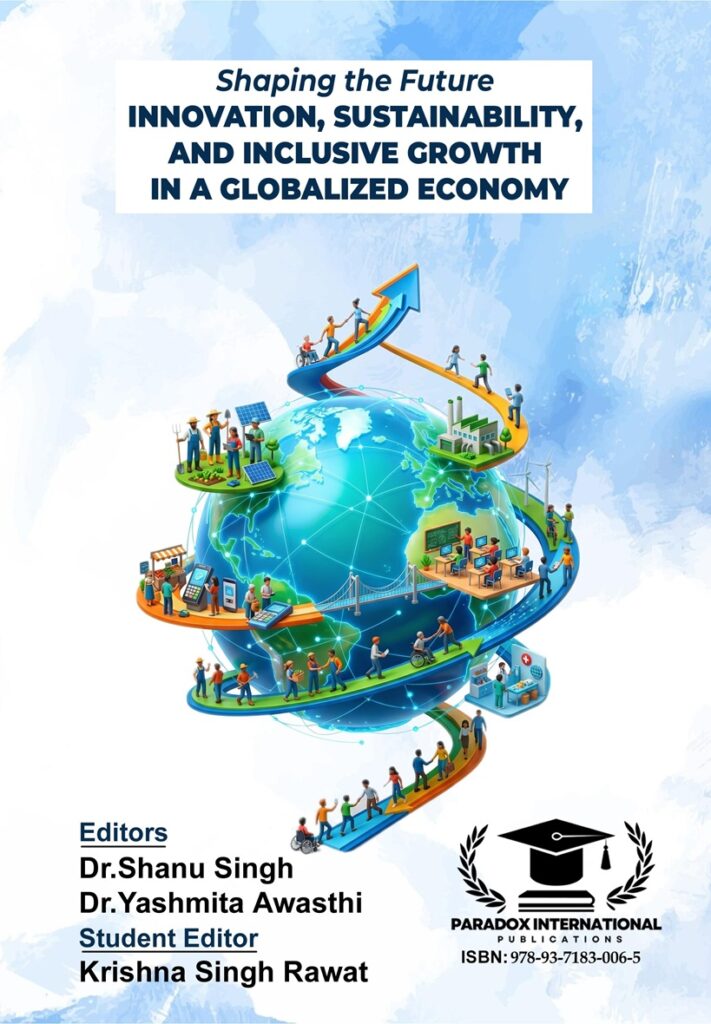
Book Title: Shaping the Future: Innovation, Sustainability, and Inclusive Growth in a Globalized Economy
Editors: Editors: Dr. Shanu Singh, and Dr. Yashmita Awasthi
Student Editor: Krishna Singh Rawat
ISBN: 978-93-7183-006-5
Chapter: 18
DOI: https://doi.org/10.59646/725/18
Authors: Kushagra Awasthi, Karthik Reddy Muthyala, Dhruv Lahoty, Garv Kher, Tanay Agarwal, and Vivan Kapoor
Abstract
The debate on fiscal federalism in India has taken a priority to differentiate between the policies of welfare state building for long term human capital formation and those as a short-term political tool. This study is motivated by an empirical question that has long puzzled researchers: why do welfare policies with similar characteristics result in such divergent development results? This paper takes two states as comparative cases, Uttar Pradesh and Telangana because they are at opposite ends of the development spectrum. This is because Uttar Pradesh is a very old state with a human development score of almost 0.5 points, while the younger southern state of Telangana has invested heavily in welfare with its flagship scheme Rythu Bandhu and recorded comparatively good human development scores. As a whole, they provide a natural experiment to separate the effects of initial conditions on policy effectiveness. The key research question is: What are the interactions between state-level initial conditions (governance quality, institutional capacity, and demographic structures) and welfare models in the context of divergent development paths? The study examines the six hypotheses, namely significant relations between state policy model development and the following: demographic factors, welfare schemes and services, welfare impact, freebie-based programs, fiscal capacity and human development indicators.