
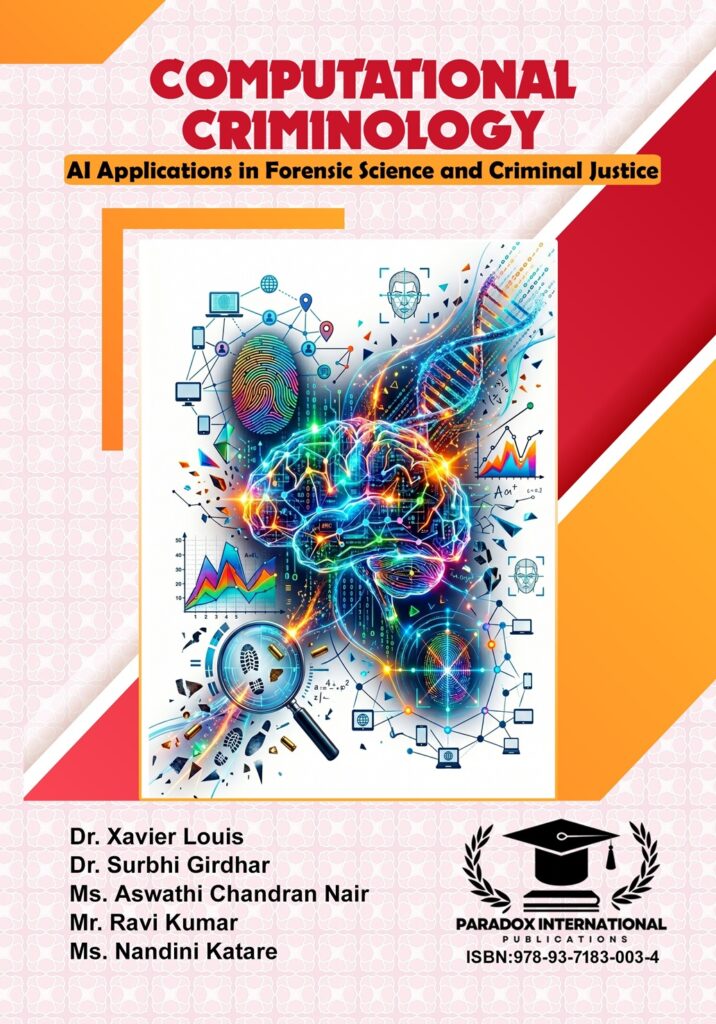
Book Title: Computational Criminology: AI Applications in Forensic Science and Criminal Justice
Editors: Dr. Xavier Louis, Dr. Surbhi Girdhar, Ms. Aswathi Chandran Nair, Mr. Ravi Kumar, and Ms. Nandini Katare
Chapter: 1
DOI: https://doi.org/10.59646/704/1
Author: Mr. S. Karthick Raja
Abstract
The relationship between science, technology, and the governance of crime has never been static. From the Bertillon system of anthropometric measurements introduced in nineteenth-century France to the neural network architectures that today parse terabytes of surveillance footage in real time, the instruments through which society has sought to understand, predict, and control criminal behaviour reflect broader epistemic commitments about the nature of knowledge, causation, and human agency.[1]
We stand, at the beginning of the third decade of the twenty-first century, at a particularly decisive inflection point: the emergence of what this volume terms “computational criminology” a distinctive epistemic project that deploys artificial intelligence, machine learning, and large-scale data analytics to address the foundational questions of criminal justice research and practice.
This chapter provides the epistemological scaffolding upon which the rest of the volume rests. It does so by interrogating three interrelated sets of questions. First, what is computational criminology, and how does it differ from and relate to adjacent fields such as quantitative criminology, forensic science, and criminal justice policy analysis?[2] Second, what are the philosophical assumptions embedded in the algorithmic turn: its claims about objectivity, prediction, and causation? Third, what are the critical tensions around bias, transparency, power, and democratic accountability that any responsible computational criminology must confront?[3]. The argument advanced here is both descriptive and normative. Descriptively, it maps the terrain of an emerging field, tracing its intellectual genealogy from classical social statistics through twentieth-century spatial criminology to contemporary machine learning applications. Normatively, it argues that computational criminology must be epistemologically self-aware: attentive to the ways, in which algorithms encode assumptions, amplify inequities, and transform the very subjects they purport to study.[4]
[1]David Garland, The Culture of Control: Crime and Social Order in Contemporary Society (University of Chicago Press, 2001) 1.
[2]Richard Berk, Criminal Justice Forecasts of Risk: A Machine Learning Approach (Springer, 2012) 7–9.
[3]Bernard Harcourt, Against Prediction: Profiling, Policing, and Punishing in an Actuarial Age (University of Chicago Press, 2007) 14.
[4]Andrew Ferguson, The Rise of Big Data Policing: Surveillance, Race, and the Future of Law Enforcement (New York University Press, 2017) 3.