
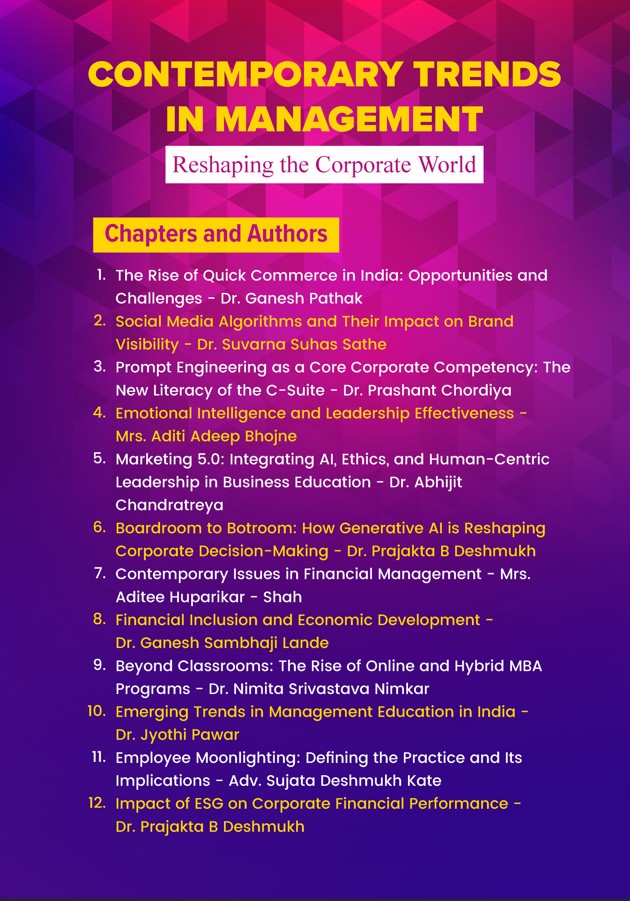
Book Title: Contemporary Trends in Management: Reshaping the Corporate World
Editors: Dr. Nilesh R. Berad and Dr. Jasbir Kaur
ISBN: 978-81-991591-9-8
Chapter: 4
DOI: https://doi.org/10.59646/ctm04/416
Author: Mrs. Aditi Adeep Bhojne
Abstract
Emotional Intelligence (EI) has become an essential trait for leaders seeking to enhance their effectiveness in today’s fast-paced and dynamic work environment. It involves the ability to recognize, understand, manage, and influence one’s own emotions and the emotions of others. This chapter explores the profound connection between Emotional Intelligence and leadership effectiveness, particularly in how it shapes decision-making, team collaboration, conflict resolution, and overall organizational success. Research indicates that leaders with high EI tend to exhibit greater interpersonal skills, empathy, and resilience, all of which contribute to a more positive and productive work culture. The chapter discusses the core components of EI, including self-awareness, self-regulation, motivation, empathy, and social skills, and examines their relevance in leadership contexts. Furthermore, it highlights how EI fosters better communication, trust-building, and employee engagement, which in turn improves leadership performance and organizational outcomes. Case studies from various industries demonstrate the impact of emotionally intelligent leadership on employee satisfaction, retention, and performance. The chapter concludes by proposing strategies for developing EI in leaders through targeted training and self-awareness practices, underscoring the importance of EI as a critical competency for effective leadership in the modern workplace.
References
- Boyatzis, R. E., Goleman, D., & Hay Group. (2002). The emotional intelligence appraisal. TalentSmart.
- Cherniss, C., & Goleman, D. (2001). The emotionally intelligent workplace: How to select for, measure, and improve emotional intelligence in individuals, groups, and organizations. Jossey-Bass.
- Goleman, D. (1995). Emotional intelligence: Why it can matter more than IQ. Bantam Books.
- Goleman, D., Boyatzis, R. E., & McKee, A. (2013). Primal leadership: Unleashing the power of emotional intelligence. Harvard Business Review Press.
- Mayer, J. D., & Salovey, P. (1997). What is emotional intelligence? In P. Salovey & D. J. Sluyter (Eds.), Emotional development and emotional intelligence: Implications for educators (pp. 3-31). BasicBooks.
- Salovey, P., & Mayer, J. D. (1990). Emotional intelligence. Imagination, Cognition, and Personality, 9(3), 185-211.