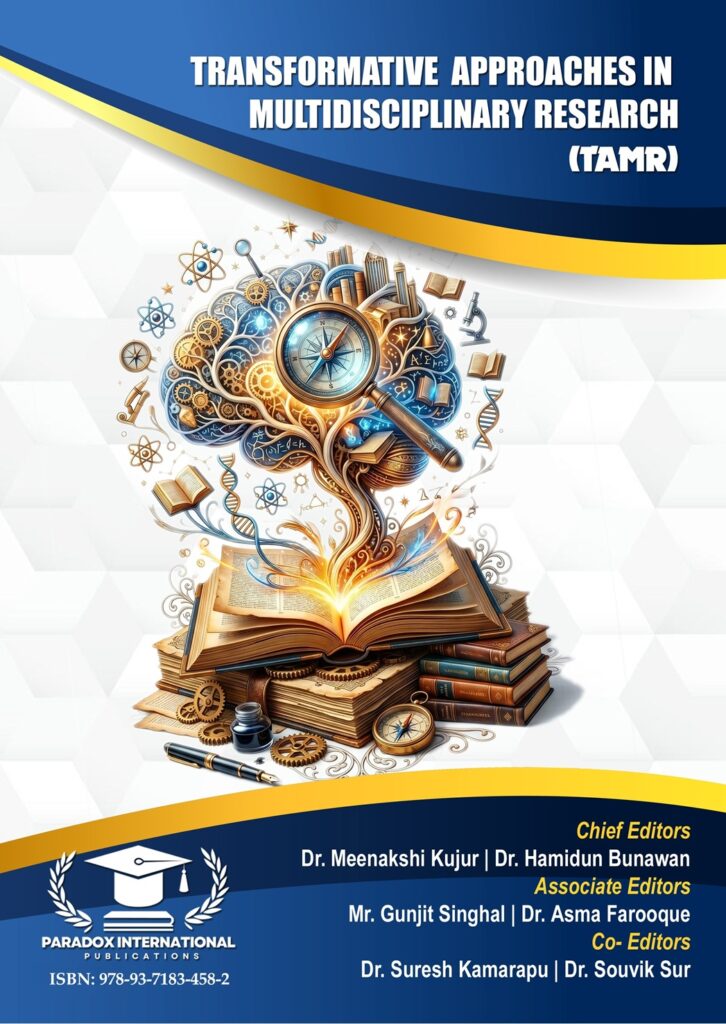
Book Title: Transformative Approaches in Multidisciplinary Research (TAMR)
Chief Editors: Dr. Meenakshi Kujur, and Dr. Hamidun Bunawan
Associate Editors: Mr. Gunjit Singhal, and Dr. Asma Farooque
Co-Editors: Dr. Suresh Kamarapu, and Dr. Souvik Sur
Chapter: 15
DOI: https://doi.org/10.59646/672/15
Authors: Jibin Mathew, and Maria J Thevara
Abstract
State-owned enterprises (SOEs) have historically played a critical role in India’s economic development, contributing to infrastructure, energy, finance, and social welfare. However, their performance has often been questioned due to inefficiencies, low profitability, and governance challenges. One major factor influencing SOE performance is political interference. Political patronage, appointment of politically connected managers, resource misallocation, and excessive government control often undermine operational efficiency and long-term competitiveness. This conceptual/review paper explores the relationship between political interference and SOE performance in India. Drawing upon global and Indian literature, the study synthesizes theoretical perspectives, identifies mechanisms of political influence, and reviews evidence on its impact on financial, operational, and social outcomes of SOEs. Comparative insights from international experiences are also highlighted to situate the Indian case in a broader context. The paper further proposes a conceptual framework linking political interference with SOE performance outcomes and concludes with recommendations for governance reforms.
References
- Aharoni, Y. (1986). The evolution and management of state-owned enterprises. Ballinger.
- Allen, F., Qian, J., & Qian, M. (2005). Law, finance, and economic growth in China. Journal of Financial Economics, 77(1), 57–116.
- Bai, C.-E., Li, D. D., Tao, Z., & Wang, Y. (2000). A multitask theory of state enterprise reform. Journal of Comparative Economics, 28(4), 716–738.
- Boardman, A. E., & Vining, A. R. (1989). Ownership and performance in competitive environments. Journal of Law and Economics, 32(1), 1–33.
- Bozec, R., & Breton, G. (2003). The impact of corporatization on SOE performance: Canadian evidence. International Journal of Public Sector Management, 16(3), 204–218.
- Borisov, A., Dudley, E., & Sarin, A. (2015). Government ownership and the cost of debt. Journal of Financial Economics, 118(1), 168–191.
- Boubakri, N., Cosset, J.-C., & Guedhami, O. (2005). Liberalization, corporate governance and the performance of privatized firms in developing countries. Journal of Corporate Finance, 11(5), 767–790.
- Buchanan, J. M., & Tullock, G. (1962). The calculus of consent. University of Michigan Press.
- CAG (Comptroller and Auditor General of India). (various years). Reports on Public Sector Undertakings. Government of India.
- Chhibber, P. K., & Gupta, S. (2019). The political economy of SOEs in emerging economies: The case of India. Asian Journal of Comparative Politics, 4(2), 153–170.
- Cuervo-Cazurra, A., Inkpen, A., Musacchio, A., & Ramaswamy, K. (2014). Governments as owners: State-owned multinational companies. Journal of International Business Studies, 45(8), 919–942.
- Cui, V., & Jiang, F. (2012). State ownership effect on firms’ FDI: Evidence from China. Journal of International Business Studies, 43(3), 264–284.
- Department of Investment and Public Asset Management (DIPAM). (various years). Disinvestment policy and transaction documents. Government of India.
- Department of Public Enterprises (DPE). (various years). Public Enterprises Survey. Government of India.
- Dewenter, K. L., & Malatesta, P. H. (2001). State-owned and privately owned firms: An empirical analysis of profitability, leverage, and labor intensity. American Economic Review, 91(1), 320–334.
- DiMaggio, P. J., & Powell, W. W. (1983). The iron cage revisited: Institutional isomorphism. American Sociological Review, 48(2), 147–160.
- Djankov, S., & Murrell, P. (2002). Enterprise restructuring in transition: A quantitative survey. Journal of Economic Literature, 40(3), 739–792.
- Dubash, N. K., & Rajan, S. C. (2001). Power politics: Economic and political drivers of India’s electricity reforms. Economic and Political Weekly, 36(35), 3367–3380.
- Estrin, S., Hanousek, J., Kocenda, E., & Svejnar, J. (2009). Effects of privatization and ownership in transition economies. Journal of Economic Literature, 47(3), 699–728.
- Faccio, M. (2006). Politically connected firms. American Economic Review, 96(1), 369–386.
- Faccio, M., Masulis, R. W., & McConnell, J. J. (2006). Political connections and corporate bailouts. Journal of Finance, 61(6), 2597–2635.
- Gandhi, A., & Walton, M. (2012). Industrial policy and state-business relations in India. In The Oxford Handbook of the Indian Economy. Oxford University Press.
- Ghosh, S., & Mohanty, R. K. (2016). Political interference and banking performance: Evidence from India. Economic and Political Weekly, 51(12), 71–79.
- Gupta, N. (2005). Partial privatization and firm performance. Journal of Finance, 60(2), 987–1015.
- Guriev, S., & Megginson, W. L. (2017). State capitalism in crisis: New evidence on SOE performance. Journal of Comparative Economics, 45(4), 899–914.
- Hemming, R., & Mansoor, A. (1988). Privatization and public enterprises. IMF Occasional Paper.
- Jensen, M. C., & Meckling, W. H. (1976). Theory of the firm: Managerial behavior, agency costs and ownership structure. Journal of Financial Economics, 3(4), 305–360.
- Kale, S. (2014). India’s public sector in historical perspective. In India Policy Forum (Vol. 10).
- Kapur, D., & Mehta, P. B. (2006). The Indian state and economic development. India Review, 5(2), 85–126.
- Kaur, I. (2013). Public sector employment and social stability in India. Indian Journal of Labour Economics, 56(3), 345–364.
- Kornai, J. (1986). The soft budget constraint. Kyklos, 39(1), 3–30.
- Kornai, J., Maskin, E., & Roland, G. (2003). Understanding the soft budget constraint. Journal of Economic Literature, 41(4), 1095–1136.
- Kumar, R., & Mishra, A. (2011). Political appointments and SOE performance: Evidence from India’s oil sector. Energy Policy, 39(3), 1677–1685.
- La Porta, R., Lopez-de-Silanes, F., & Shleifer, A. (2002). Government ownership of banks. Journal of Finance, 57(1), 265–301.
- Lewis-Faupel, S., Neggers, Y., Olken, B. A., & Pande, R. (2016). Can electronic procurement improve infrastructure provision? American Economic Journal: Economic Policy, 8(3), 258–283.
- Lin, J. Y., Cai, F., & Li, Z. (1998). Competition, policy burdens, and state-owned enterprise reform. American Economic Review, 88(2), 422–427.
- Majumdar, S. K. (1996). Assessing comparative efficiency of the state-owned, mixed, and private sectors in Indian industry. Public Choice, 96(1–2), 1–24.
- Megginson, W. L. (2017). Privatization, state capitalism, and state ownership of business in the 21st century. Now Publishers.
- Megginson, W. L., & Netter, J. M. (2001). From state to market: A survey of empirical studies on privatization. Journal of Economic Literature, 39(2), 321–389.
- Ministry of Finance (India). (various years). Economic Survey of India. Government of India.
- Ministry of Heavy Industries (India). (2021). Guidelines on CPSE board appointments and performance evaluation. Government of India.
- Ministry of Power (India). (2017). UDAY Scheme: Outcome evaluation. Government of India.
- Mishra, R. K., & Gupta, S. (2010). Public sector enterprises in India: Reforms and reorganization. Institute of Public Enterprise.
- Mooij, J. (1999). Food policy and politics: The political economy of India’s Public Distribution System. Journal of Peasant Studies, 26(2–3), 77–101.
- Musacchio, A., & Lazzarini, S. G. (2014). Reinventing state capitalism: Leviathan in business, Brazil and beyond. Harvard University Press.
- Nayyar, D. (2001). The challenges of reforming India’s public sector. Economic and Political Weekly, 36(13), 1127–1136.
- NITI Aayog. (2018). Strategy for New India @ 75. Government of India.
- OECD. (2005). OECD Guidelines on Corporate Governance of State-Owned Enterprises. OECD Publishing.
- OECD. (2015). OECD Guidelines on Corporate Governance of State-Owned Enterprises (2015 Edition). OECD Publishing.
- OECD. (2018). Ownership and governance of state-owned enterprises: A compendium of national practices. OECD Publishing.
- Pande, R., & Udry, C. (2005). Institutions and development: A view from below. In Proceedings of the Econometric Society World Congress.
- Panagariya, A. (2008). India: The emerging giant. Oxford University Press.
- Pargendler, M. (2012). State ownership and corporate governance. Fordham Law Review, 80(6), 2917–2973.
- Peng, M. W., Bruton, G. D., Stan, C. V., & Huang, Y. (2016). Theories of the (state-owned) firm. Asia Pacific Journal of Management, 33(2), 293–317.
- Planning Commission (India). (2011). Report of the Committee on Restructuring of CPSEs. Government of India.
- Rajan, R. G., & Zingales, L. (1998). Financial dependence and growth. American Economic Review, 88(3), 559–586.
- Ramaswamy, K. (2001). Corporate governance in India: The case of public sector enterprises. Vikalpa, 26(2), 23–40.
- RBI (Reserve Bank of India). (various years). Report on the trend and progress of banking in India.
- Sarkar, S. (2017). Air India and the political economy of national carriers. Economic and Political Weekly, 52(25), 34–41.
- Sarkar, J., & Sarkar, S. (2000). Large shareholder activism in corporate governance in developing countries: Evidence from India. International Review of Finance, 1(3), 161–194.
- SEBI (Securities and Exchange Board of India). (2015). Listing Obligations and Disclosure Requirements Regulations.
- SEBI. (2021). Corporate Governance in Listed Entities: Independent Directors—Circular.
- Shirley, M., & Walsh, P. (2000). Public vs. private ownership: The current state of the debate. World Bank Policy Research Working Paper.
- Shleifer, A. (1998). State versus private ownership. Journal of Economic Perspectives, 12(4), 133–150.
- Shleifer, A., & Vishny, R. W. (1994). Politicians and firms. Quarterly Journal of Economics, 109(4), 995–1025.
- Singh, N., & Srinivasan, T. N. (2005). Indian federalism, economic reform, and growth. India Policy Forum, 1, 1–36.
- Subbarao, D. (2012). Public sector banks: Time to introspect. RBI Speeches.
- TanZi, V. (1997). The changing role of the state in the economy. IMF Working Paper.
- Thakur, R. (2014). Corporate governance in Indian CPSEs: Emerging issues. Journal of Public Enterprise, 39(2), 1–20.
- Trivedi, P. (1990). Ownership, incentive and control in state enterprises: Theory and evidence from India. In P. Bardhan (Ed.), The Economic Theory of Agrarian Institutions. Oxford University Press.
- Vagliasindi, M. (2008). Governance arrangements for state-owned enterprises. World Bank Policy Research Working Paper.
- Vickers, J., & Yarrow, G. (1991). Economic perspectives on privatization. Journal of Economic Perspectives, 5(2), 111–132.
- World Bank. (2014). Corporate governance of state-owned enterprises: A toolkit. World Bank.
- World Bank. (2015). India systematic country diagnostic. World Bank.
- World Bank. (2020). India economic update: Unlocking productivity. World Bank.
- Zhang, Y., & Freestone, O. (2013). State-owned enterprises in China: Reform dynamics. Economic Roundup (2).
- Steel Authority of India Limited, Annual Reports (Various Years).
- Oil and Natural Gas Corporation Limited, Annual Reports (Various Years).
- Coal India Limited, Annual Reports (Various Years).
- Indian Oil Corporation Limited, Annual Reports (Various Years).
- Ministry of Finance, Department of Investment and Public Asset Management. (2023). Annual report 2022–23. Government of India.
- Central Electricity Regulatory Commission. (2019). Terms and conditions of tariff regulations, 2019. Government of India.