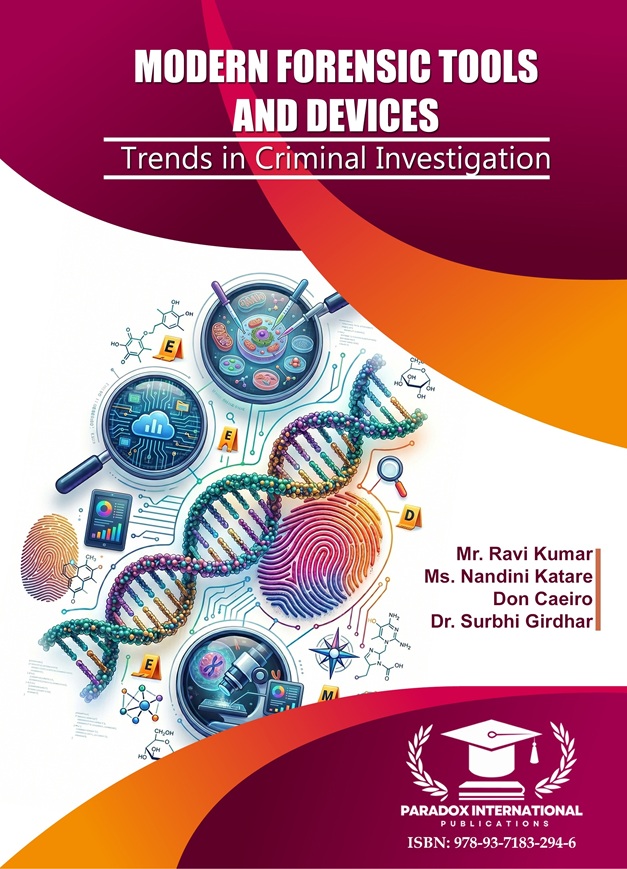
Book Title: Modern Forensic Tools and Devices: Trends in Criminal Investigation
Editors: Mr. Ravi Kumar, Ms. Nandini Katare, Don Caeiro, and Dr. Surbhi Girdhar
Chapter: 8
DOI: https://doi.org/10.59646/658/8
Author: Apoorva Narad
Abstract
Forensic toxicology, a critical discipline within criminal investigations, has witnessed substantial advancements in recent years, largely driven by the development of sophisticated analytical instrumentation and methodologies (Vaishnav et al., 2023). These developments are essential for identifying and quantifying drugs and toxins in biological matrices, which is crucial for addressing the increasing complexity of cases involving substances of abuse and environmental exposures. The continuous introduction of novel psychoactive substances and the intricate nature of drug metabolism further complicate the analytical landscape, necessitating highly sensitive and specific detection techniques (Casparsen, 2024). Consequently, modern forensic toxicology has evolved to encompass a broader scope, moving beyond traditional drug categorization to adopt multiclass and multiresidue analytical procedures capable of general screening for unknown substances across diverse forensic contexts (Vincenti et al., 2012). This evolution underscores the imperative for continuous innovation in analytical strategies and interpretative frameworks to accurately assess the impact of toxic agents in legal and public health contexts (Chandan, 2024). This chapter will delve into the cutting-edge analytical instruments currently employed in forensic toxicology, exploring their principles, applications, and limitations. It will also address the persistent interpretative challenges associated with post-mortem toxicology and the metabolism of emergent compounds, offering insights into how ongoing research and instrumental improvements are enhancing the field’s capabilities and reliability. Specifically, this review integrates recent publications in forensic toxicology, spanning from 2016 to 2019, to delineate progress in areas such as toxicological surveillance, challenges posed by substances of forensic interest, and advancements from sample preparation to interpretative stages. The demanding technical and intellectual scope of modern forensic toxicology necessitates a comprehensive understanding of these advancements to ensure accurate and reliable results in medicolegal investigations.