
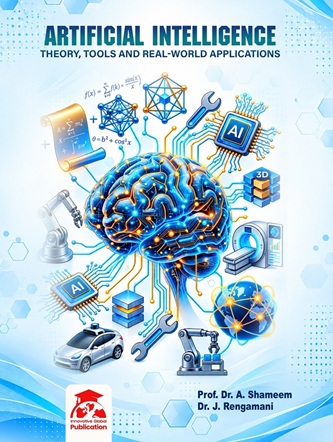
Title: Artificial Intelligence: Theory, Tools and Real-World Applications
Editors: Prof. Dr. A. Shameem and Dr. J. Rengamani
ISBN: 978-81-69857-67-3
Chapter: 1
DOI: https://doi.org/10.59646/819/22
Author: Dr. V. A. Jane
Abstract
Generative Artificial Intelligence (AI) is transforming higher education by enhancing teaching, learning, research, and administrative processes. AI-powered tools such as ChatGPT, Gemini, and Copilot assist students in personalized learning, content creation, problem-solving, and academic support. Educators can use these technologies to design course materials, automate assessments, and improve student engagement. Additionally, generative AI supports research activities by assisting in data analysis, literature reviews, and academic writing. Despite its numerous benefits, the adoption of generative AI presents significant challenges, including concerns about academic integrity, data privacy, ethical use, bias in AI-generated content, and the potential overreliance of students on technology. Institutions must establish clear policies, promote responsible AI usage, and develop digital literacy skills among students and faculty to maximize the benefits while minimizing risks. This paper explores the practical applications of generative AI in higher education, highlighting both the opportunities it creates and the challenges that must be addressed for its effective and ethical integration.
Keywords: Generative AI, Higher Education, Artificial Intelligence, Personalized Learning, Academic Integrity, Digital Education, AI Ethics, Educational Technology, Student Learning, Research Support.