
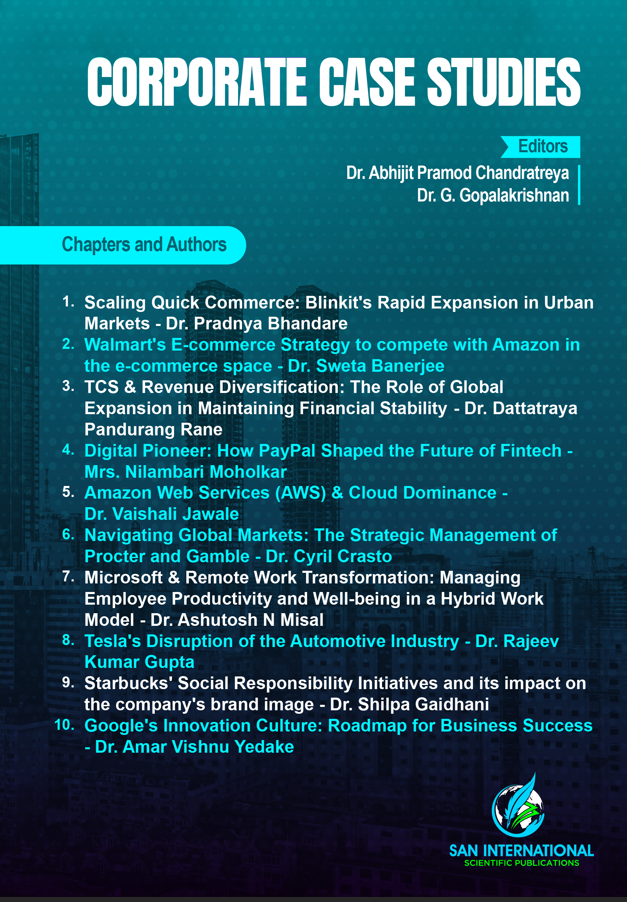
Book Title: Corporate Case Studies
Editors: Dr. Abhijit Pramod Chandratreya and Dr. G. Gopalakrishnan
ISBN: 978-81-986047-8-1
Chapter: 1
DOI: https://doi.org/10.59646/csc1/327
Author: Dr. Pradnya Bhandare
Abstract
Blinkit is at the forefront of the fast-paced retail revolution that is changing the way people shop in cities. Blinkit has revolutionized convenience for millions of people in big cities with its promise of minute-long delivery of necessities. This section delves into the approaches used to break into new markets, streamline operations, and expand the company’s reach. Blinkit has built a strong foundation that distinguishes it from the competitive rapid commerce field by using state-of-the-art technology, streamlined logistics, and smart relationships. Statistics, case studies, and practical applications illuminate Blinkit is path in this chapter. Businesses aiming to expand in this space may learn a lot from the company’s strategy, which includes overcoming logistical difficulties and meeting increasing customer expectations. Infrastructure constraints, regulatory worries, and profitability demands are some of the other obstacles we cover. This in-depth study sheds light on Blinkit is business strategy, its effect on city marketplaces, and the way rapid commerce is likely to develop in the future.
References
- Agarwal, P. (2021). The rise of quick commerce in India: A market analysis. Journal of Retail and Consumer Services, 58(3), 12-18.
- Banerjee, S., & Verma, R. (2020). Dark stores and the future of e-grocery delivery. International Journal of Supply Chain Management, 27(4), 45-52.
- Choudhury, A. (2023). Blinkit’s business model: Strategies for rapid expansion. Harvard Business Review India, 41(2), 30-37.
- Das, K., & Srinivasan, P. (2022). Consumer behavior in quick commerce: The case of Blinkit. Journal of Consumer Research, 49(1), 25-32.
- Gupta, V. (2020). Logistics challenges in hyperlocal delivery networks. Transportation Research Part E: Logistics and Transportation Review, 139, 101-110.
- Iyer, M., & Sharma, T. (2021). How instant grocery delivery is reshaping urban markets. Economic and Political Weekly, 56(19), 15-22.
- Kapoor, R. (2024). The role of venture capital in scaling quick commerce startups. Journal of Business Venturing, 39(3), 55-63.
- Mehta, A., & Nair, S. (2023). Sustainability concerns in rapid urban delivery services. Sustainable Business Review, 12(6), 78-86.
- Patel, J. (2019). The gig economy and its impact on quick-commerce logistics. Journal of Business Economics, 50(7), 99-108.
- Ramesh, K., & Bhattacharya, P. (2022). Digital payments and consumer retention in instant commerce. FinTech Journal, 15(4), 35-42.
- Sane S, Anute N, and Limbore N (2022) Taking Advantage of Consumer Ethnocentrism: A Potential Strategic Tool, Journal of Pharmaceutical Negative Results, Volume 13, Special Issue 9, Page no. 6905-6913.
- Saxena, H. (2021). Competitive dynamics among quick-commerce players: Blinkit vs. Swiggy Instamart. Indian Journal of Marketing, 62(2), 20-28.
- Sharma, N., & Singh, P. (2023). Last-mile delivery efficiency in Indian quick commerce. International Journal of Logistics Research and Applications, 28(5), 88-95.
- Verma, S. (2020). The economic viability of 10-minute grocery delivery. Harvard Business Review India, 37(6), 58-65.
- Yadav, R. (2024). Technology-driven supply chain innovations in urban commerce. Journal of Retail Innovation, 33(1), 102-110.
- Zaveri, T., & Kumar, M. (2023). Workforce challenges in the quick-commerce sector. Labour Economics Review, 45(3), 67-75.