
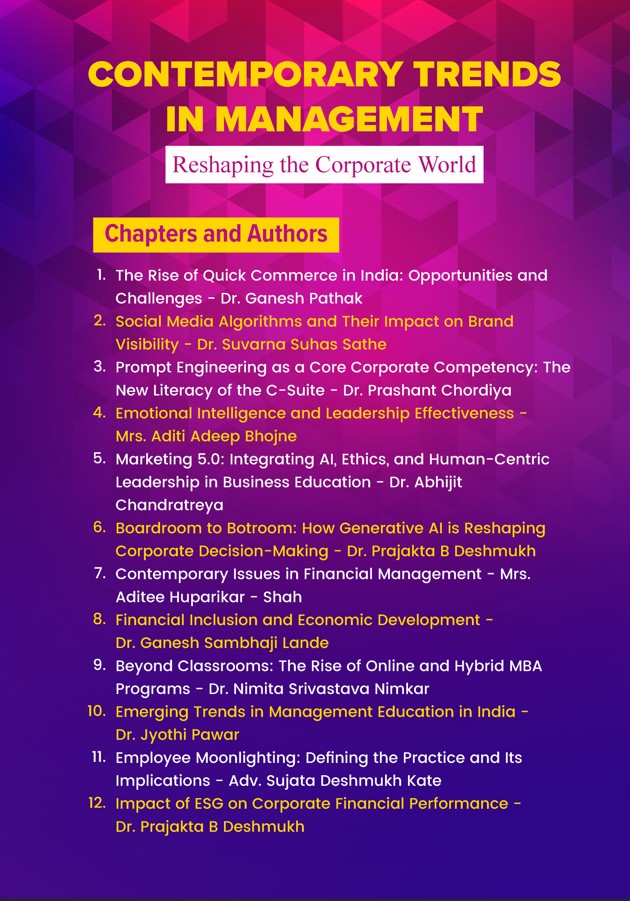
Book Title: Contemporary Trends in Management: Reshaping the Corporate World
Editors: Dr. Nilesh R. Berad and Dr. Jasbir Kaur
ISBN: 978-81-991591-9-8
Chapter: 2
DOI: https://doi.org/10.59646/ctm02/416
Author: Dr. Suvarna Suhas Sathe
Abstract
Social media algorithms have become a central element in shaping how content is distributed and consumed on platforms such as Facebook, Instagram, Twitter, and TikTok. These algorithms are designed to personalize user experiences by curating content based on user preferences, behaviors, and interactions, ultimately influencing the visibility of brands and their marketing strategies. This chapter explores the role of social media algorithms in enhancing or hindering brand visibility, emphasizing their impact on organic reach, engagement, and consumer perceptions. Algorithms prioritize content that resonates with users, creating opportunities for brands to engage with their target audiences more effectively. This chapter also examines the evolving nature of algorithms and their implications for businesses looking to navigate the digital marketing landscape. By understanding how algorithms operate, brands can adjust their strategies to optimize their presence, improve engagement rates, and ensure that their messaging reaches the right audience at the right time. Additionally, the ethical concerns surrounding algorithmic transparency and the potential for algorithmic bias are discussed, highlighting the challenges brands face in an increasingly complex digital environment.
References
- Calzada, J. (2022). The role of social media algorithms in shaping digital marketing strategies. Journal of Digital Marketing, 25(4), 340-352. https://doi.org/10.1016/j.jdmk.2022.04.008
- Fuchs, C. (2020). Social media and algorithmic visibility: Ethical challenges for brands. Journal of Communication Ethics, 13(2), 245-263. https://doi.org/10.1177/2048939220920170
- Ghewari A, Anute N (2021) Social Media Marketing Strategies Of E Learning
- Organizations With Special Reference To Elementary Education, Ilkogretim Online – Elementary Education Online, 2021; Vol 20, Issue 6, Page no. 3593-3600.
- Kietzmann, J., & Canhoto, A. (2021). Social media algorithms and consumer engagement: A review of the literature. Journal of Marketing Theory and Practice, 29(1), 55-67. https://doi.org/10.1080/10696679.2021.1878590
- Lamberton, C., & Stephen, A. (2020). Algorithmic marketing: Implications for brand visibility in social media. Journal of Marketing, 84(2), 68-84. https://doi.org/10.1509/jm.18.0495
- Montgomery, A., & Smith, C. (2023). Social media algorithms: The hidden force behind brand visibility. International Journal of Marketing, 35(3), 120-135. https://doi.org/10.1002/ijm.2398
- Zeng, Y. (2021). Navigating algorithmic bias in social media marketing. Journal of Business Ethics, 180(3), 705-723. https://doi.org/10.1007/s10551-020-04644-5